

Kerendia® Cardiovascular Outcomes
In patients receiving standard of care, including a maximum tolerated dose of ACEi/ARB therapy…
Kerendia® (finerenone) significantly reduced the risk of the primary CV composite endpoint vs. placebo. †
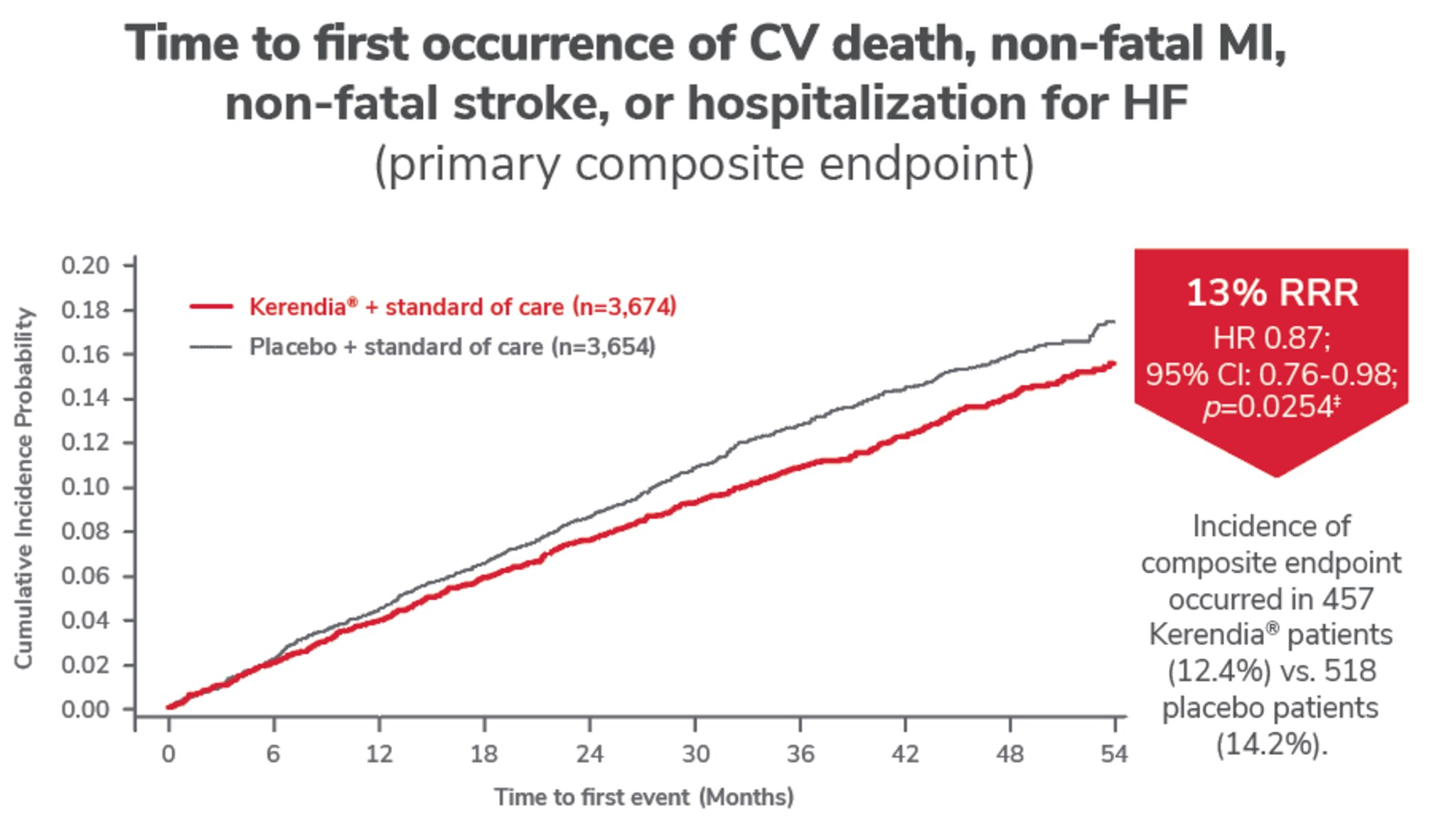
The NNT to prevent one primary outcome event was 47 (95% CI: 26-226) on the basis of an absolute between-group difference of 2.1 percentage points (95% CI, 0.4-3.8) after 3.5 years.†
- Individual composite endpoint components:
- HF hospitalization: 3.2% vs. 4.5% placebo (HR 0.71; 95% CI: 0.56-0.90)
- CV death: 5.3% vs. 5.9% placebo (HR 0.89; 95% CI: 0.73-1.08)
- Non-fatal MI: 2.8% vs. 2.8% placebo (HR 1.00; 95% CI: 0.76-1.32)
Non-fatal stroke: 2.9% vs. 3.0% placebo (HR 0.97; 95% CI: 0.74-1.26)
Click here for additional safety information and for a link to the product monograph:
Kerendia® (finerenone) is indicated as an adjunct to standard of care therapy in adults with chronic kidney disease (CKD) and type 2 diabetes (T2D) to reduce the risk of:
- End-stage kidney disease and a sustained decrease in estimated glomerular filtration rate,
- Cardiovascular death, non-fatal myocardial infarction and hospitalization for heart failure (HF).
Consult the Product Monograph at www.bayer.com/sites/default/files/kerendia-pm-en.pdf for important information about:
- Contraindications in patients receiving concomitant systemic treatment with strong CYP3A4 inhibitors and in patients with Addison’s disease.
- Relevant warnings and precautions regarding avoiding concomitant use of Kerendia® with potassium-sparing diuretics and other mineralocorticoid receptor antagonists; caution with concomitant use of Kerendia® with potassium supplements, trimethoprim, or trimethoprim-sulfamethoxazole; additional monitoring with concomitant use of weak or moderate CYP3A4 inhibitors; avoiding concomitant use of moderate or strong CYP3A4 inducers; avoiding concomitant intake of grapefruit or grapefruit juice; avoiding use in patients with severe impairment (Child Pugh C); additional monitoring in patients with moderate hepatic impairment (Child Pugh B); risk of hyperkalemia and more frequent monitoring in high-risk patients; initiation not recommended if serum potassium > 5.0 mmol/L; initial and ongoing monitoring and management of patients based on serum potassium and estimated glomerular filtration rate (eGFR); ongoing monitoring of renal function and initiation and use in patients with eGFR <25 mL/min/1.73 m2; greater risk of glomerular filtration rate decrease; events related to worsening renal function in patients with HF with left ventricular ejection fraction ≥40%; avoiding use during pregnancy; use of effective contraception; avoid use during breast-feeding; potentially greater sensitivity in some geriatric patients (≥65 years of age).
- Conditions of clinical use, adverse reactions, drug interactions, and dosing instructions.
The Product Monograph is also available by calling 1-800-265-7382 or emailing canada.medinfo@bayer.com.
PP-KER-CA-0561-1